
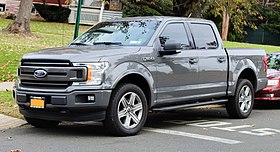
The Ford F-Series is a series of light-duty trucks marketed and manufactured by Ford Motor Company since the 1948 model year. The F-Series is marketed as a range of full-sized pickup trucks positioned above the midsize Ranger but below the larger Super Duty in the Ford truck lineup.[1] Alongside the F-150 (introduced in 1975), the F-Series also includes the Super Duty series (introduced in 1999), which includes the heavier-duty F-250 through F-450 pickups, F-450/F-550 chassis cabs, and F-600/F-650/F-750 Class 6–8 commercial trucks.
History
The F-Series was first introduced in 1948 as a replacement for a previous pickup model line based on car platforms.
The most popular version of the model line is the F-150 pickup truck, currently in its fourteenth generation (introduced for the 2021 model year). From 1953 to 1983, the entry-level F-Series pickup was the 1⁄2 ton F-100. Starting in 1984, the F-150 became the entry-level. The F-150 has a long-running high-performance off-road trim level introduced for 2010, the (SVT) Raptor currently consisting of three generations. Production of the F-150 SVT Raptor ended in 2014 and it was planned to be succeeded by a new F-150 Raptor, which is based on the thirteenth and fourteenth generation F-150.
The F-Series trucks have been developed into a wide range of design configurations. Alongside medium-duty trucks and “Big Job”[clarification needed] conventional trucks (the forerunners of the Ford L-series), the model line has been marketed as a chassis-cab truck and a panel van (a predecessor of the Ford E-Series). The F-Series has served as the platform for various full-sized Ford SUVs, including the Ford Bronco, Ford Expedition/Lincoln Navigator, and Ford Excursion. The F-Series has been marketed by its three North American brands: by Mercury as the M-Series (in Canada from 1948 to 1968), and by Lincoln in the 2000s, as the Blackwood and the later Mark LT (2010s for the latter in Mexico only).
Since 1977, the F-Series has remained the best-selling pickup truck line in the United States; it has been the best-selling vehicle overall since 1981.[2][3] The F-Series has been the best-selling truck in Canada for over fifty years.[4][5][6] As of the 2018 model year, the F-Series generated $41 billion (~$49 billion in 2023) in annual revenue for Ford.[7] By January 2022, the F-Series models have sold over 40 million units.[8] Currently, Ford manufactures the F-Series in four facilities in the United States.
First generation (1948–1952)
Main article: Ford F-Series (first generation)
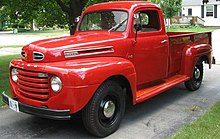
1950 Ford F-3
The first-generation F-Series pickup (known as the Ford Bonus-Built) was introduced in 1948 as a replacement for the previous car-based pickup line introduced in 1942. The F-Series was sold in eight different weight ratings, with pickup, panel truck, cab-over engine (COE), conventional truck, and school-bus chassis body styles.
Second generation (1953–1956)
Main article: Ford F-Series (second generation)
(Left): 1953 F100 build diagram; (right): 1956 F-100
For the 1953 model year, Ford introduced a second generation of the F-Series trucks. Increased dimensions, improved engines, and an updated chassis were features of the second generation. In another change, the model nomenclature of the F-Series was expanded to three numbers; this remains in use in the present day. The half-ton F-1 became the F-100; the F-2 and F-3 were combined into the 3⁄4-ton F-250, while the F-4 became the one-ton F-350. Conventional F-Series trucks were F-500 to F-900; COE chassis were renamed C-Series trucks.
While the cabs, doors, radiator support, inner fenders, and hoods are the same from 1953 to 1956 F-100 and F-250s (the fenders varied on F-250, F-350, and F-500, and long boxes were only available on the F-250), in 1956, the cab underwent a major revision. Centered around a wraparound windshield, the cab was given new doors, a redesigned dashboard, and an (optional) panoramic rear window. In line with Ford cars, the 1956 F-Series offered seat belts as an option.
This was the final generation with separate front fenders.
Third generation (1957–1960)
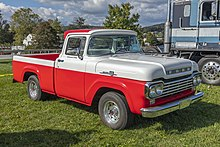
1959 F-100
Main article: Ford F-Series (third generation)
Introduced in 1957, the third generation F-Series was a significant modernization and redesign. Front fenders became integrated into the body, and the new “Styleside” bed continued the smooth lines to the rear of the pickup.
The cab-over F-Series was discontinued, having been replaced by the tilt-cab C-Series.
In 1959, Ford began its very first production of factory four-wheel-drive pickups.
Fourth generation (1961–1966)
Main article: Ford F-Series (fourth generation)
1964 F-100
Ford introduced a dramatically new style of pickup in 1961 with the fourth-generation F-Series. Longer and lower than its predecessors, these trucks had increased dimensions and new engine and gearbox choices. Additionally, the 1961–1963 models offered an optional unibody design with the cab and bed integrated. The traditional separate cab/bed was offered concurrently. The unibody proved unpopular, and Ford discontinued the option after the 1963 model year.
In 1965, the F-Series was given a significant mid-cycle redesign. A completely new platform, including the “Twin I-Beam” front suspension, was introduced, and continued to be used until 1996 on the F-150, and is still used today in the F-250 and F-350 4×2. Additionally, the Ranger name made its first appearance in 1965 on a Ford pickup; previously, the Ranger denoted a base model of the Edsel, but starting in 1965, it was used to denote a high-level styling package for F-Series pickups.[9]
Fifth generation (1967–1972)
1968 F-100
Main article: Ford F-Series (fifth generation)
Introduced in 1967, the fifth-generation F-Series pickup was built on the same platform as the 1965 revision of the fourth generation. Dimensions were increased, engine options were expanded, and plusher trim levels became available during the fifth generation’s production run.
Changes during the 1967–1972 run were minimal, but notable. In 1968, to comply with FMVSS (Federal Motor Vehicle Safety Standards), marker lights were added to the rear bedside and front sides of the hood. 1970 saw a switch from metal bar style grillwork to the plastic eggcrate style.
Sixth generation (1973–1979)
Main article: Ford F-Series (sixth generation)
1979 F-250 Ranger
The sixth-generation F-Series was introduced in 1973. This version of the F-Series continued to be built on the 1965 fourth-generation’s revised platform, but with significant modernization and refinements, including front disc brakes, increased cabin dimensions, full double-wall bed construction, and increased use of galvanized steel.
The FE engine series was discontinued in 1976 after a nearly 20-year run, replaced by the more modern 335 and 385 series engines.
In 1975, the F-150 was introduced in between the F-100 and the F-250 to avoid certain emission control restrictions. For 1978, square headlights replaced the previous models’ round ones on higher-trim-package models, such as Lariat and Ranger, and became standard equipment for 1979. Also for 1978, the Ford Bronco was redesigned into a variant of the F-Series pickup; 1979 was the last year that the 460 engine was available in a half-ton truck.
Seventh generation (1980–1986)
Main article: Ford F-Series (seventh generation)
1986 F-150 XL
The seventh-generation F-Series was introduced for 1980, marking the first ground-up redesign of the model line since 1965. Alongside an all-new chassis, the pickup trucks received a completely new body. While distinguished by straighter body lines, the aerodynamics of the exterior were optimized to improve fuel economy. Sharing their cab structure with F-Series pickup trucks, medium-duty trucks (F-600 through F-800) underwent their first redesign since 1967.
The powertrain line of this generation underwent multiple revisions through its production. At its launch, the engine line was largely carried over from 1979. While the 7.5L V8 was dropped entirely (in half-tons), a 4.2L V8 was introduced as the smallest V8 engine. For 1982, a 3.8L V6 became the standard engine for the F-100. For 1983, to improve the fuel efficiency of the model line, the M-Series engines (the 5.8L 351M and 6.6L 400 V8s) were dropped; the latter was replaced by the return of the 7.5L V8. In response to low demand and poor performance, the 4.2L V8 and 3.8L V6 were phased out in 1982 and 1983, respectively. For the F-250 and F-350, a 6.9L diesel V8 (sourced from a partnership with International Harvester) became an option for 1983. For 1984, a high-output version of the 5.8L V8 was introduced. The 5.0L V8 was fitted with fuel injection as standard equipment for 1986, becoming the first fuel-injected engine in an American-market pickup truck. The 4.9L was fuel injected on 1987 models.
In line with the previous generation, the SuperCab and four-door crew cab made their return in 1980 and 1982, respectively. For the first time, a dual-rear-wheel version of the F-350 was offered as a pickup truck.
For 1982, Ford revised the badging of the model line, replacing the “FORD” hood lettering with the Ford Blue Oval grille emblem, a design that remains in use on all F-Series trucks today (except the Raptor). The same year, the Ranger trims was dropped; the name shifted to the Ford Ranger compact pickup (replacing the Ford Courier). After 30 years as the smallest F-Series truck, the F-100 was dropped after 1983, eliminating model overlap with the F-150 (and payload overlap with the Ranger).
This generation was the final version of the F-Series to offer a three-speed, column-shifted manual transmission; it is also the second-to-last vehicle sold in the United States with this configuration.
Eighth generation (1987–1991)
Main article: Ford F-Series (eighth generation)
1987-1991 F-150
The eighth-generation F-Series was introduced for 1987 as a major revision of the 1980–1986 generation. While the cab’s sheet metal was carried over, many body panels were revised, including a completely new front fascia; the interior also underwent a redesign. The long-running Flareside bed design was retired (until its return in the 1992 ninth-generation), with all examples produced with Styleside beds (except for a very small number of 1987 models).
Following the 1986 transition of the 5-liter V8 to fuel injection, the 4.9-liter inline-six followed suit for 1987, with the 5.8- and 7.5-liter engines doing so for 1988; the F-Series became the first American pickup truck model line sold without a carbureted engine option. The same year, the 6.9-liter diesel V8 was increased in size to 7.3 liters. Following the discontinuation of the three-speed manual, a five-speed manual became standard equipment (a four-speed remained a special-order option until 1992). For 1989, an E4OD four-speed automatic (overdrive version of the C6 heavy-duty three-speed) was introduced.
Slotted between the F-350 and F-600, the F-Super Duty was introduced in 1987 for the 1988 model year; an ancestor of the current F-450/F-550, the F-Super Duty was designed exclusively for chassis-cab applications.
Ninth generation (1992–1997)
Main article: Ford F-Series (ninth generation)
1993 Ford F-150, with dual fuel tanks
The ninth-generation F-Series was introduced for 1992 as the second redesign of the 1980 F-Series architecture. Adapting design elements from the newly introduced Explorer and redesigned E-Series and Ranger, the F-Series received a slightly lower hood line, rounding the front fenders, bumper, and grille. The light-duty F-Series received a driver-side airbag starting in the 1994 model year.
After a six-year hiatus, the Flareside bed made its return, becoming a sub-model of the F-150. To appeal to younger buyers, the bodywork of the Flareside bed was modernized, adapting the fenders of the dual-rear-wheel F-350 to a single-rear-wheel chassis. Also unlike previously, dual tanks became available on Flareside models, but only on 2WD models, and the Flareside bed was available with the SuperCab in addition to the regular cab.
To commemorate the 75th anniversary of the first Ford factory-produced truck (the 1917 Ford Model TT), Ford offered a 75th-anniversary package on its 1992 F-Series, consisting of a stripe package, an argent-colored step bumper, and special 75th-anniversary logos. In response to the Chevrolet 454SS pickup truck, Ford introduced the SVT Lightning, powered by a 240 hp 5.8L V8.[citation needed]